JUCJET
JUCJET TK11(8) Quad Band Ham Radio | 10W, Metal, 3000mAh
JUCJET TK11(8) Quad Band Ham Radio | 10W, Metal, 3000mAh
Bulk pre-order · teams only (from 10 radios)
Out of stock in your region right now. Teams and businesses can pre-order 10 radios or more. No payment now: we confirm lead time and compliance for your country, then email you a payment link.
Four Amateur Bands, a Wideband Receiver and a Metal Front Panel.
The JUCJET TK11(8) is a quad band handheld for licensed amateur operators. It transmits on the 10 m, 6 m, 2 m and 70 cm amateur bands, at up to 10 W on 2 m and 70 cm, and its receiver covers 0.153–1160 MHz in AM, FM, SSB and CW. It is the TK11 with a metal front panel and a larger 3000 mAh battery. Factory-direct, sold and supported by JUCJET.
⚠️ Transmitting on amateur frequencies requires a valid amateur radio licence in your country. Air band, broadcast (including shortwave broadcast) and weather reception is listen-only — check local rules before you monitor.
What Sets It Apart
- Four amateur bands — 10 m and 6 m at up to 5 W, 2 m and 70 cm at up to 10 W, with High / Medium / Low power. US version: 28–29.7, 50–54, 144–148 and 420–450 MHz. EU/UK version: 28–29.7, 50–52, 144–146 and 430–440 MHz. An amateur radio licence is required to transmit.
- 0.153–1160 MHz receive with SSB — AM, FM, USB, LSB and CW, with 0.1 kHz fine tuning on medium wave and shortwave. Plug in the included T-shape antenna for 0.153–18 MHz listening.
- Spectrum analyser and frequency meter — see activity around a centre frequency (128 kHz to 6.4 MHz span), or hold a nearby radio close and read its frequency and CTCSS/DCS tone, then save it as a channel.
- Dual receive and dual PTT — watch two frequencies at once and transmit on either one with its own PTT key.
- Metal front panel, 3000 mAh battery — the TK11(8) swaps the grey front shell of the TK11(5) for a metal front panel and carries a 7.4 V 3000 mAh battery; charge it in the desktop base or top up through USB-C.
- Everyday ham features — 999 named channels, CTCSS/DCS, DTMF and 5-tone calling, 1750 Hz repeater tone, repeater offset, VOX, cross-band operation, noise reduction, custom power-on image and PC programming.
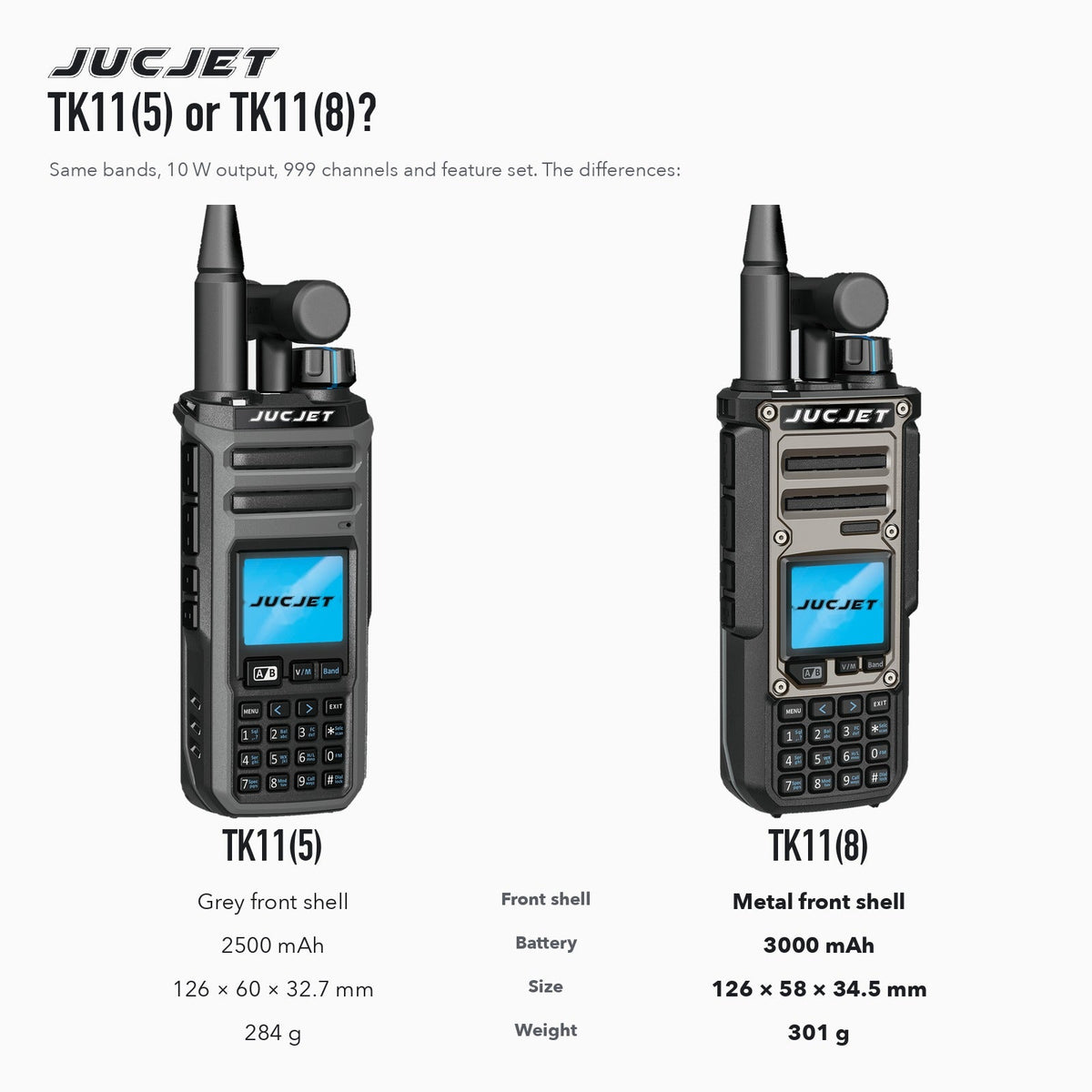
TK11(5) or TK11(8)?

Both radios share the same bands, output power, 999 channels, receiver and features. Choose the TK11(8) for the metal front panel and the bigger battery; choose the TK11(5) if you want the lighter radio.
- Front shell: TK11(5) grey front shell · TK11(8) metal front panel
- Battery: TK11(5) 2500 mAh · TK11(8) 3000 mAh
- Size: TK11(5) 126 × 60 × 32.7 mm · TK11(8) 126 × 58 × 34.5 mm
- Weight: TK11(5) 284 g · TK11(8) 301 g
Four Bands, Clearly Labelled

Transmit bands depend on the version you receive. Both versions receive 0.153–1160 MHz.
Medium Wave and Shortwave, Finely Tuned

Choose USB, LSB or CW with the 8 key and tune in 0.1 kHz steps. Reception depends on the antenna, conditions and your location.
Air Band, Receive Only

Scan 108–136 MHz and press 8 to select AM. The TK11(8) cannot transmit on the air band.
Up to 10 W on 2 m and 70 cm

Use the power level your licence and local rules allow; 10 m and 6 m run at up to 5 W.
Controls and Ports

Headset/data port, T-shape antenna port, dual PTT, two side keys, torch on top, USB-C port and desktop charging contacts.
Specifications
- Transmit — US version: 28–29.7 MHz and 50–54 MHz (up to 5 W), 144–148 MHz and 420–450 MHz (up to 10 W); EU/UK version: 28–29.7 MHz and 50–52 MHz (up to 5 W), 144–146 MHz and 430–440 MHz (up to 10 W). Amateur bands — licence required
- Output power: High / Medium / Low selectable
- Receive: 0.153–1160 MHz; AM, FM, USB, LSB, CW
- Receive sensitivity: FM −121 dBm, wide FM −108 dBm, AM −100 dBm
- Channels: 999 memory channels, 10 NOAA weather channels
- Channel spacing: 25 kHz / 12.5 kHz (16K0F3E / 11K0F3E)
- Frequency stability: ±1 ppm; antenna impedance: 50 Ω
- Speaker: 16 Ω, 1 W; audio output ≥0.5 W
- Display: 1.44-inch; keypad: 19 front keys, 2 PTT keys and 2 side keys
- Front panel: metal
- Battery: 7.4 V 3000 mAh Li-ion
- Size and weight: 126 × 58 × 34.5 mm, 301 g
- Charging: desktop charging base; USB-C on the radio
- Programming: keypad, frequency meter, wireless Air Copy, PC software
- FCC ID: XBPTK11-8 (receiver authorization under FCC Part 15)
In the Box

- TK11(8) radio ×1
- Li-ion battery 3000 mAh ×1
- High-gain antenna (50 / 144 / 430 MHz) ×1
- T-shape antenna (0.153–18 MHz) ×1
- Desktop charger ×1
- Adapter ×1
- Belt clip ×1
- Lanyard ×1
- User manual ×1
Speaker microphones, earpieces and a longer shortwave antenna are sold separately and are not included.
FAQ
Do I need a licence?
Yes, to transmit. The TK11(8) transmits on amateur bands, and using them requires an amateur radio licence from your national regulator. It is not a licence-free PMR446 or FRS radio — if you need one of those, see our licence-free models.
What is the difference between the TK11(5) and the TK11(8)?
The bands, power, receiver and features are the same. The TK11(8) has a metal front panel and a 3000 mAh battery (126 × 58 × 34.5 mm, 301 g); the TK11(5) has a grey front shell and a 2500 mAh battery (126 × 60 × 32.7 mm, 284 g).
Which transmit bands will my radio have?
The US version transmits on 28–29.7, 50–54, 144–148 and 420–450 MHz. The EU/UK version transmits on 28–29.7, 50–52, 144–146 and 430–440 MHz. Both receive 0.153–1160 MHz.
Can it receive shortwave and SSB?
Yes. Fit the included T-shape antenna and choose AM, USB, LSB or CW. Reception depends on the antenna, conditions and your location; a longer shortwave antenna (sold separately) helps above 18 MHz.
Can I transmit on the air band or shortwave broadcast bands?
No. Air band (108–136 MHz AM) and broadcast reception, including the shortwave broadcast bands, is listen-only. Rules on monitoring aviation traffic differ by country, so check yours.
Does NOAA weather work outside North America?
The 10 NOAA channels and SAME alerts receive US and Canadian weather broadcasts. Elsewhere those channels are usually silent; the rest of the receiver works as normal.
How far can it talk?
We do not quote a range figure. On 2 m and 70 cm at up to 10 W, range depends on terrain, antenna height and obstructions: open line of sight goes furthest; buildings, trees and hills shorten it. A local repeater extends coverage.
How do I program it?
From the keypad and menu, by reading a nearby radio with the frequency meter, by wireless Air Copy from another TK11(8), or from a PC with programming software.
Can I use it while charging?
You can listen, though reception may be weaker while charging. The manual says not to transmit while charging from the base or USB-C.
Shipping & Returns
Shipping & Returns
Free standard shipping. EU orders ship from our Germany warehouse, UK orders from our UK warehouse and US orders from our US warehouse; orders are processed within 1–3 business days and usually delivered within 3–7 business days. 30-day returns. 2-year warranty.